The Journey to a Self-Aware Autonomous RAN

If your network’s AI system decided right now, without human approval, to reallocate spectrum, shift traffic loads and deprioritize a category of users to protect service quality during a peak event, would you let it? Most operators wouldn’t. Not yet.
When an autonomous system makes a consequential decision without engineer sign-off, the operator owns the outcome. In telecommunications, where networks support emergency services, financial transactions and millions of people’s working lives, that is a weight most organizations aren’t ready to carry yet. This is the reason why the industry is stuck.
According to NVIDIA’s State of AI in Telecom report, 54% of telecom operators are already using AI for network planning and optimization. Yet more than half of those organizations remain trapped in pilot programs, unable to move AI into production at scale. Most vendors can demonstrate impressive autonomous capabilities in controlled environments, but they lack confidence.
The journey to a self-aware autonomous RAN is about building trust through evidence, not deploying more AI. It’s also not about climbing an abstraction ladder of autonomy levels, but about systematically building the evidence that allows an organization, and the engineers inside it, to trust what the network does when no one is watching.
What Does a Self-Aware RAN Mean?
The term “self-aware network” is often used, but what does it mean?
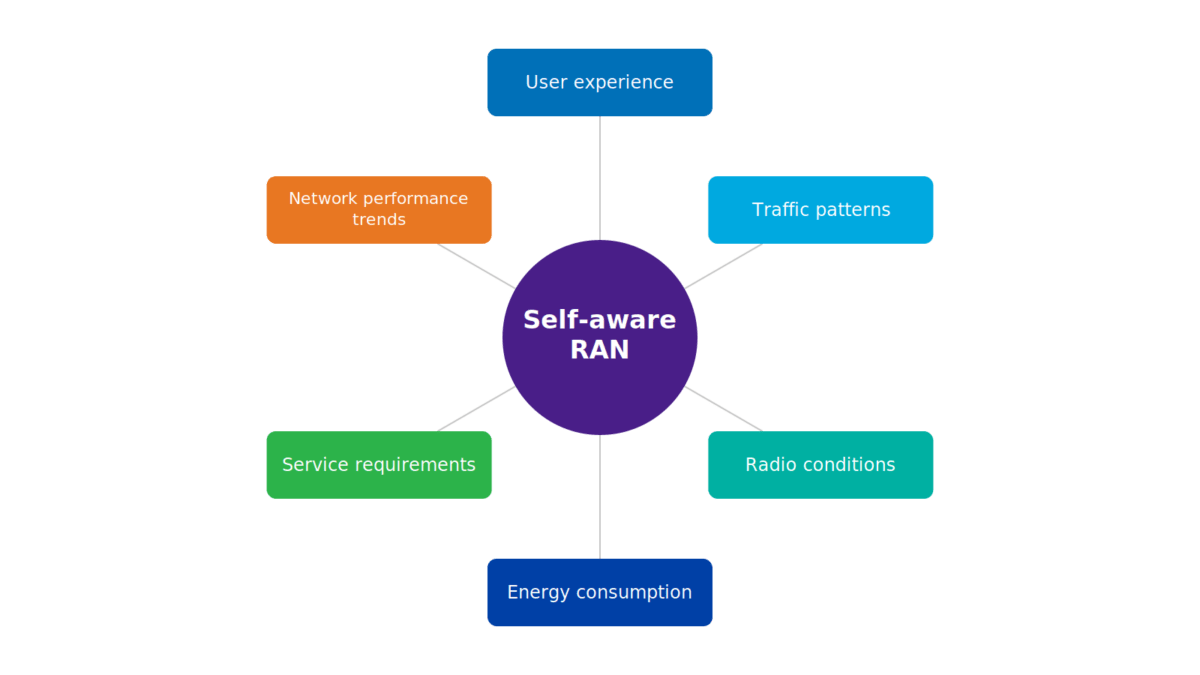
A self-aware RAN does more than react to predefined events. It understands its environment and the impact of its actions, including user experience, traffic patterns, radio conditions, energy consumption, service requirements, and network performance trends.
Most importantly, it learns.
Consider a busy city center. Traffic demand changes throughout the day as commuters travel, businesses open, events begin and crowds move across the network. A conventional network responds according to preconfigured rules.
A self-aware network recognizes emerging patterns, predicts likely outcomes and automatically selects the most appropriate response to achieve a desired business objective, whether that is improving user experience, reducing energy consumption or maintaining service quality. That ability to learn and adapt is what separates automation from autonomy.
The Road to Autonomy
The TM Forum Autonomous Networks framework describes six levels of network maturity, from fully manual operations to fully autonomous intent-driven networks.
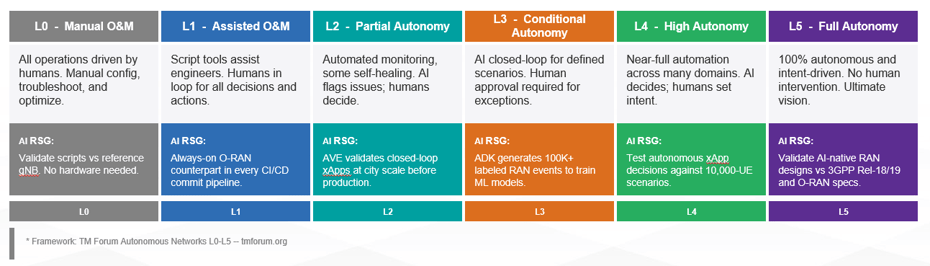
Most operators are currently targeting Level 3, where networks can perform closed-loop actions in defined scenarios while humans remain responsible for exceptions and oversight.
A small number of operators have already demonstrated advanced autonomous capabilities in specific domains, proving that the journey is achievable.
However, every step up the autonomy ladder requires operators to answer the same questions:
- Can the network accurately understand its current state?
- Can it identify and diagnose problems?
- Can it predict outcomes?
- Can it make the right decision?
- Can it explain that decision?
- Can it learn from the results?
Where Autonomous Networks Are Already Delivering Value
The path to autonomy is a series of practical use cases that solve real operational challenges. Each one is an opportunity to build evidence along with confidence.
Energy Optimization
Energy costs represent up to 25% of a mobile operator’s total operating expenditure, and base station power consumption is the single largest contributor. Autonomous energy management sounds straightforward: let the network learn demand patterns, switch off underutilized resources and protect experience during busy periods.
An AI model trained on average traffic behavior will perform well most of the time. But what happens during an unplanned event – a stadium emptying early, a city-centerpower outage rerouting traffic – make real-life conditions look nothing like the training data? In production, you find out the hard way but in simulation, you find out before it matters.
This is precisely why energy optimization is one of the most common first use cases for organizations deploying AI validation environments. The stakes are high enough to justify the effort, and the operational patterns are understood enough to model. The consequences of a wrong autonomous decision, from degraded service to poor customer experience during peak periods, are visible, measurable and costly.
Mobility and Handover Optimization
Billions of handover decisions happen across mobile networks every day. Most of them are invisible to subscribers. The ones that aren’t, such as dropped calls, stalled video streams, a connection that takes five seconds to recover, are the ones that drive churn.
AI-driven handover optimization has shown genuine promise. Models can learn radio conditions, movement patterns and historical outcomes to make better predictions than static rule sets. But the challenge is that handover decisions interact with everything else happening in the network simultaneously. An optimization that improves performance in one cell can create congestion in an adjacent one.
Testing handover AI in isolation tells you half the story. Testing it in a simulated environment that models the full network, including the knock-on effects of each decision, tells you whether it’s actually ready.
Closed-Loop Operations
In a closed-loop environment, the network detects a problem, diagnoses its cause, selects a corrective action, implements it and validates the outcome, without a human approving each step. For congestion management, traffic steering and service assurance, this capability can dramatically reduce resolution times and operational load. It can also go wrong in ways that are difficult to predict in advance.
The failure modes that matter most in closed-loop systems are rarely the obvious ones. They tend to be interactions – two autonomous processes responding to the same signal simultaneously, each making a locally rational decision that is globally counterproductive. Or it could be a feedback loop where a corrective action changes the conditions that triggered it, causing the system to oscillate rather than stabilize.
These failure modes don’t surface in unit testing. They surface in realistic, high-fidelity simulation, which is why validating closed-loop logic before it touches production is one of the most important investments an operator can make on the road to autonomy.
AI Training and Validation
Every autonomous capability ultimately depends on the quality of its underlying AI model, which depends on one thing above all others: the data it was trained on.
Production networks generate enormous volumes of data, but that data is heavily skewed toward normal operating conditions. The rare events like major failures, unusual traffic patterns, edge-case interactions, are exactly what autonomous systems most need to handle well, and exactly what is most underrepresented in training data. Synthetic scenario generation changes this equation.
By creating controlled environments where rare events can be simulated at scale, organizations can train models against conditions they have never encountered in production and validate how those models behave before they are trusted with real decisions.
The Common Thread
Each use case represents a point where autonomous decision-making creates value, and where the consequences of a poorly validated autonomous decision are real and measurable. Each requires operators to answer the same question before extending trust further: how do we know this will work the way we think it will, under conditions we haven’t seen yet? Who tests AI to ensure it is reliable, secure and trustworthy?
The answer is a disciplined validation process that exposes AI systems to the full complexity of what they will face in production before they face it. That process is what separates the operators who are scaling autonomous capabilities from the ones who are still running pilots.
Building Confidence Before Deployment
Autonomous systems learn through testing, validation and experience. However, operators can’t experiment freely on live production networks.
An AI model that performs well under laboratory conditions may behave differently when exposed to real-world complexity, unexpected traffic patterns or interactions with other AI-driven applications. As autonomy increases, validation becomes more important.
Operators need environments where they can safely:
- Establish performance baselines.
- Model real-world network conditions.
- Train and refine AI systems.
- Validate outcomes objectively.
- Deploy with confidence.
Market Momentum Continues to Build
The business case for autonomous networks is becoming increasingly compelling:
- 54% of telecom operators already use AI for network planning and optimization.
- More than half of telecom organizations are still struggling to move beyond pilot deployments.
- Industry analysts consistently identify autonomy as a key requirement for managing the growing complexity of future 5G and 6G networks.
- TM Forum reports that Level 3 autonomy remains the primary near-term target for most operators as they seek to achieve closed-loop operational capabilities.
Together, these trends reveal that the industry agrees on the destination, but many organizations are still working out how to get there.
Getting Started
For most operators, the journey begins with focused use cases, such as energy optimization, traffic steering, handover optimization, capacity management, service assurance, and network quality monitoring
The goal is building trust, one validated use case at a time, rather than immediate full autonomy.
As organizations progress, technologies such as digital twins, simulation platforms and AI validation environments become increasingly important. These capabilities allow operators, vendors and developers to train, test, and validate autonomous behaviors before introducing them into production.
This is where a RAN Simulation Digital Twin based on the VIAVI TeraVM AI RAN Scenario Generator (AI RSG) supports the journey.
Rather than being the destination itself, AI RSG provides a controlled environment where organizations can model realistic network behavior, train AI applications, and validate autonomous decisions before deployment. This controlled environment is fundamental to building the trust that autonomous networking demands. By repeatedly exposing AI systems to simulated edge cases, failure modes and peak-demand scenarios, organizations can observe how models behave under pressure and intervene before those behaviors ever touch a live network. Each successful validation cycle adds a layer of verified confidence, giving network engineers and stakeholders the tangible evidence they need to extend greater autonomy to AI-driven systems over time. Trust is earned through demonstrated, repeatable performance in conditions that mirror the complexity of the real world.
The Future Belongs to Networks That Know Themselves
The autonomous RAN isn’t a product you buy or a project you complete. It is an organizational capability you build, one validated decision at a time.
The operators who get there first won’t necessarily be the ones with the largest AI budgets or the most aggressive deployment timelines. They’ll be the ones who invested early in the necessary work: baselining network behavior, creating realistic test environments, validating AI decisions before those decisions go live, and building the confidence to extend autonomy further each time.
At VIAVI, we built the RAN Simulation Digital Twin powered by AI RSG specifically for this part of the journey. If you’re navigating it, we’d like to help.
Read the previous blog to learn how VIAVI AI RSG helps organizations build that confidence, step by step, from AI pilots to production-ready autonomous networks.