Tools for Emulating and Testing AI Workloads
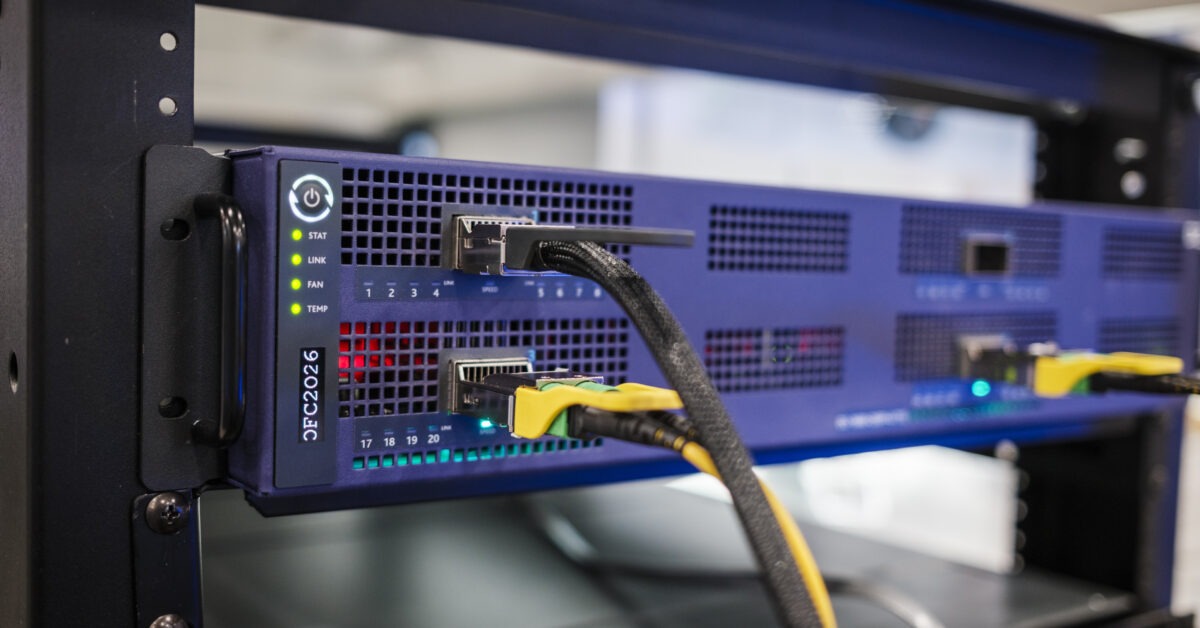
As hyperscale facilities shift toward 1.6T Ethernet and prepare for 3.2T, the methodology for network testing must be upgraded.
Validation of High-Speed Ethernet (HSE) and data center fabrics needs to take place across all layers, from OSI Layer 0 (the medium) to 7 (the application, including security). This means that we need to not only test the optical dispersion within the fiber itself but also emulate traffic and cyberattacks to ensure the network’s complete resilience.
Below we examine the OSI Layers and introduce how VIAVI’s suite of HSE tools enables 800G and 1.6T validation across all of them.
The Open System Interconnection (OSI) Model
The OSI model was created in the mid-1980s by the International Organization for Standardization (ISO) to accurately describe the interactions that happen within a network’s infrastructure.
OSI defined the network as having just seven protocol layers, with Layer 1 (the physical layer) relating to the movement of raw bits. Today, the need to validate the medium itself (the fiber or copper in which the bits move) is also needed and Layer 0 is typically also included.
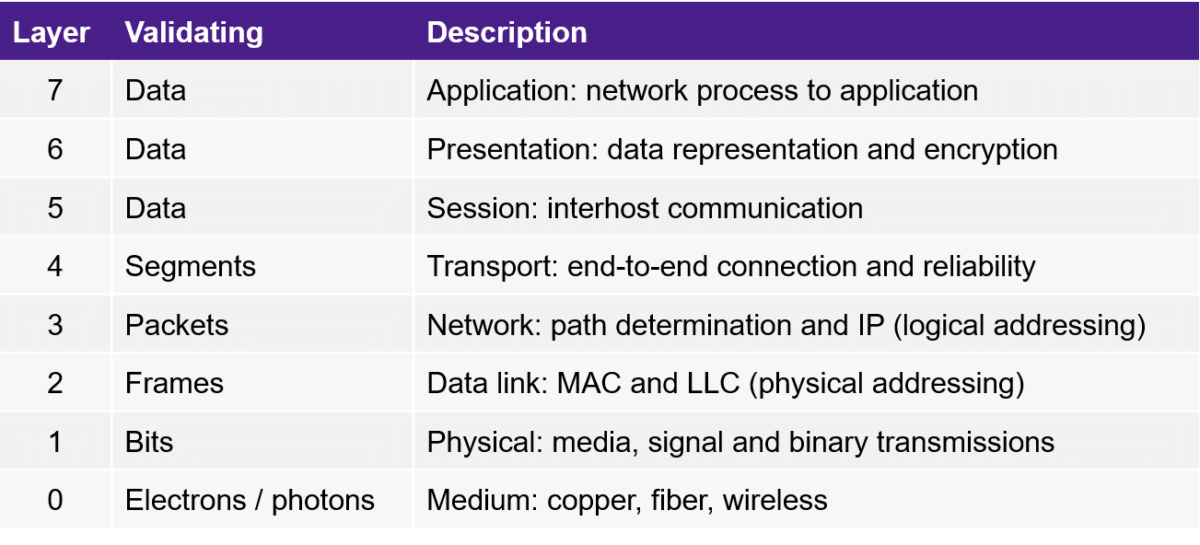
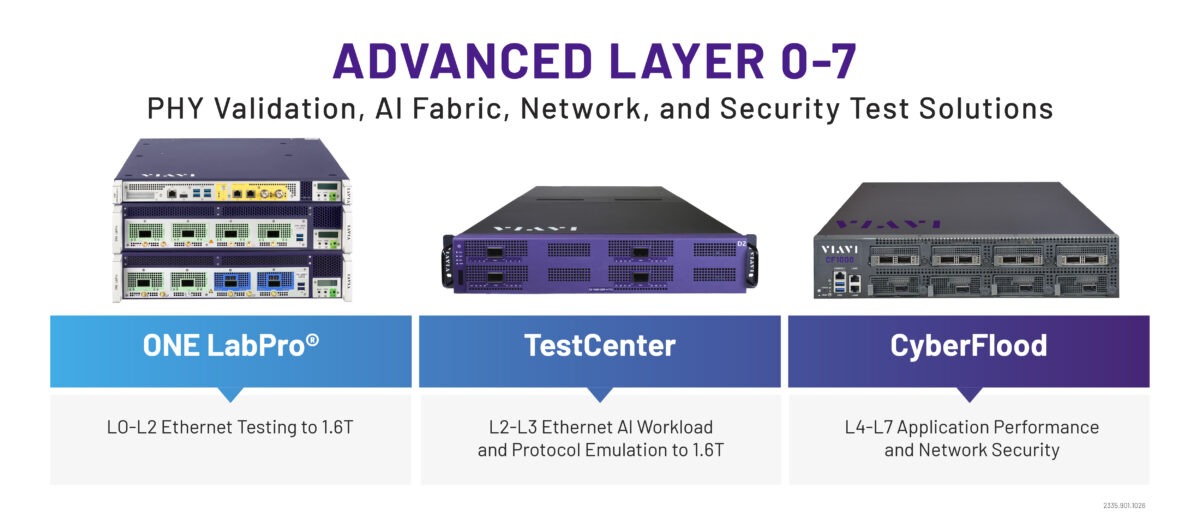
While there is no one system capable of testing at all layers, VIAVI is unique in its ability to provide single-vendor validation of the entire network stack.
Verifying Signals and Physical Interfaces
VIAVI’s ONE LabPro is a high‑performance Ethernet test and validation platform designed for multi‑rate, multi‑port performance testing at Layers 0-2 in networks operating at up to 1.6T.
The system integrates physical layer insight, traffic generation/analysis, and protocol benchmarking (including MAC and IP), with support for key performance test standards in lab and live environments.
This family includes the ONE-1600ER module, which provides full eight-lane 200G (1.6T) high-speed Ethernet support based on the latest 802.3dj specification. The system analyzes 200G lanes at 224G SerDes with native support for riding heat sink (RHS) OSFP 1600G modules, and delivers comprehensive RFC2544 for full performance testing.
Breaking its use down to each network layer, for Layer 0, like the 8100 Series OTDR, the ONE-1600ER module can be used for both standard and HCF characterization but also integrates functions for testing L1 and L2. At the physical layer (L1), the system undertakes both 112G and 224G SerDes bring-up and margining, and Ethernet 800G / 1.6T PCS/PMA functional validation. Additionally, it’s available in modules that provide Integrated Heat Sink (IHS), Riding Heat Sink (RHS), or a combination that provides both to maximize support coverage. For the data link (L2), it enables RoCEv2 readiness testing, MAC/link-layer conformance/regression testing, and the validation of LACP stability.
Verifying Network Behavior & ScalabilityVIAVI TestCenter D2 1.6T Appliance enables L2 and L3 testing. This system is a high-capacity Ethernet traffic generator, AI workload emulator, analyzer, and protocol emulation platform that has been specifically engineered for multi-terabit test environments within modern data centers using AI-scale Ethernet fabrics (800G – 1.6T and beyond).
As such, it can push extremely high Ethernet traffic loads and analyze latency, loss, congestion behavior, and protocol performance, with use cases including switch and router hardware validation, AI data center fabric testing, interoperability testing, and hyperscale network validation. To achieve these, its functions include buffer depth absorption and equal-cost, multi-path load balancing, RoCEv2 congestion control and failure recovery scenarios, as well as switch compatibility analysis for multi-vendor networks.
Again, if we dig into its functionality at each layer, we see that at L2, Ethernet fabric validation is undertaken by exercising link-state transitions and drain/fill cycles under full 1.6T bidirectional load. Additionally, this is backed up by the validation of data center bridging (DCB) and RoCEv2 link-layer readiness.
At the network layer (L3), the TestCenter D2 1.6T Appliance is able to undertake both IPv4/6 mixed fabric performance with forwarding validation, and AI fabric and GPU simulation with massive flow-scale, creating thousands upon thousands of simulated flows.
Validating Performance and Security
As organizations scale AI workloads, they face pressure to deliver low-latency, high-throughput inference. To be economically viable, this also requires large economies of scale and security through cyber resilience. Specifically, performance issues or downtime can lead to financial loss and erode trust, and security breaches can expose sensitive data from AI models.
VIAVI CyberFlood can be used across the remaining four OSI layers to predict AI data center performance and confirm resilience to attacks. It delivers scalable, high-fidelity client emulation to generate realistic AI inference workloads, simulating real user interactions with LLMs, LLM APIs, and backend inference services using advanced stateful session modeling.
Breaking this down by OSI Layer, at the transport layer (L4), CyberFlood enables firewall exhaustion testing and verifying load balancer performance. At the session Layer (L5), it undertakes stateful inspection validation, testing security gateways and proving zero-trust architectures.
For the presentation layer (L6), HTTPS inspection with SSL decryption in firewalls is run to test security policies tied to encrypted traffic. Finally, at the application layer (L7), it can validate DDoS protection, the API gateway, and run firewall benchmarking.
Summary
By accurately replicating real‑world network topologies and conditions including traffic and congestion, organizations can eliminate the need for large physical test beds, simplifying debugging while reducing both risk and cost in data center development and evolution.
Emulation can be used across all OSI Layers, and is particularly useful for validating layers L2 to L7 when preparing for 1.6 and 3.2T, where devices under test would be exposed to cross-layer protocol interactions and timing-sensitive behavior. The interoperability of equipment from multiple vendors and the ability to scale can also be verified.
More information on the products listed can be found here.