Why First-time Interference Resolution is More than Just an Efficiency Target
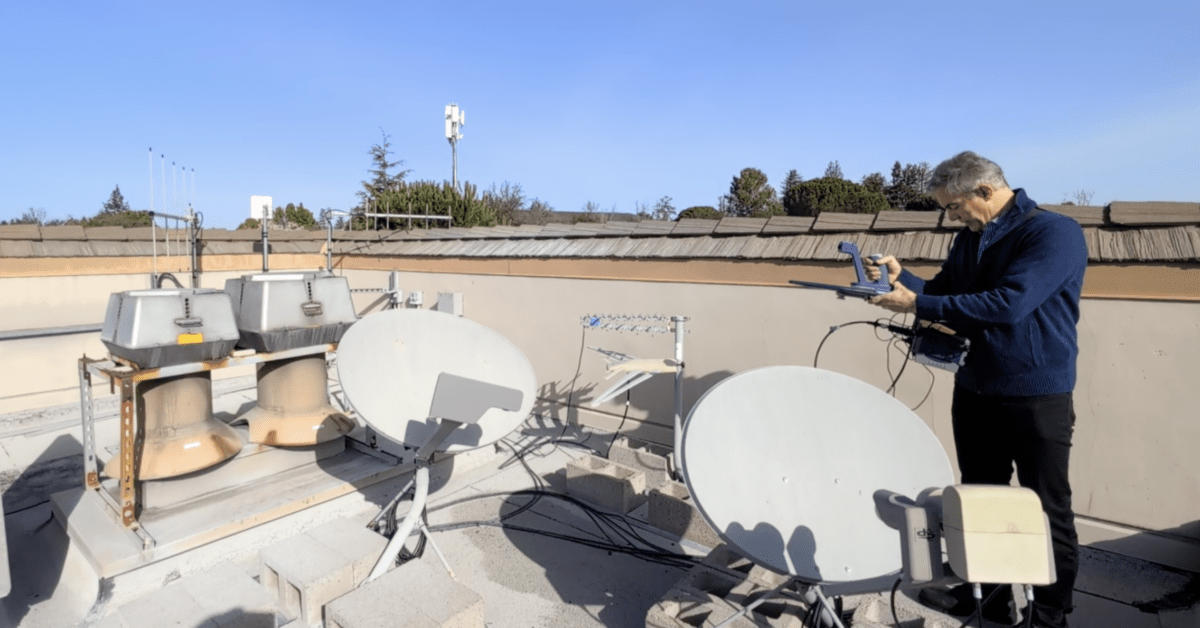
Traditional spectrum analyzers display signal frequency and power level but provide no spatial correlation to the physical environment.
Following an RF interference alarm, standard protocol dictates that an RF technician walks the site, takes multiple measurements, and makes an educated guess based on the available data to assess the emitter’s location. These best guesses are typically affected by reflections and/or secondary sources, and most interference resolution attempts therefore require multiple site visits.
Repeat visits increase mean time to repair (MTTR), extend network impairments, increase truck-roll costs, and expose field personnel to unnecessary safety hazards on rooftops and elevated structures. This creates measurable costs and business risks for the affected communication service provider, defense network, or public safety agency.
In this blog we’ll examine how this issue is being addressed by VIAVI’s RF Viewer, with the overlaying of real-time RF signal strength data onto an image of the physical environment, and how this enables the identification of interference sources in a single visit.
Why Spectrum Analyzers Show the Signal But Not the Source
Spectrum analyzers can precisely characterize an RF signal’s amplitude and frequency, but not from where those emissions originate in three-dimensional space.
A technician using a spectrum analyzer must correlate a numeric readout or trace display with the physical surroundings: antennas, coax runs, adjacent tenant equipment, rooftop HVAC units, and so on. Every measurement becomes an interpretation exercise.
Field data from major tier-one operators indicate that initial interference (PIM) resolution attempts can fail because technicians tighten connectors or replace components that are not connected to the issue based on their visual inspection. The result: wasted labor, unnecessary material consumption, and extended customer dissatisfaction.
For PIM specifically, the act of walking around the site can suppress the interference, with each footstep on a rooftop causing small flexes that can create intermittent contact changes that can temporarily hide PIM signatures caused by loose or corroded metal connections.
The Importance of Augmented Reality
RF Viewer addresses the spatial correlation gap with an augmented reality interface.
Specifically, it overlays a color-coded RF-signal-strength heat map onto real-time images of the physical environment captured by an integrated camera. The heatmap is created and updated by sweeping the antenna horizontally and vertically with areas of elevated RF emission highlighted in red and orange.
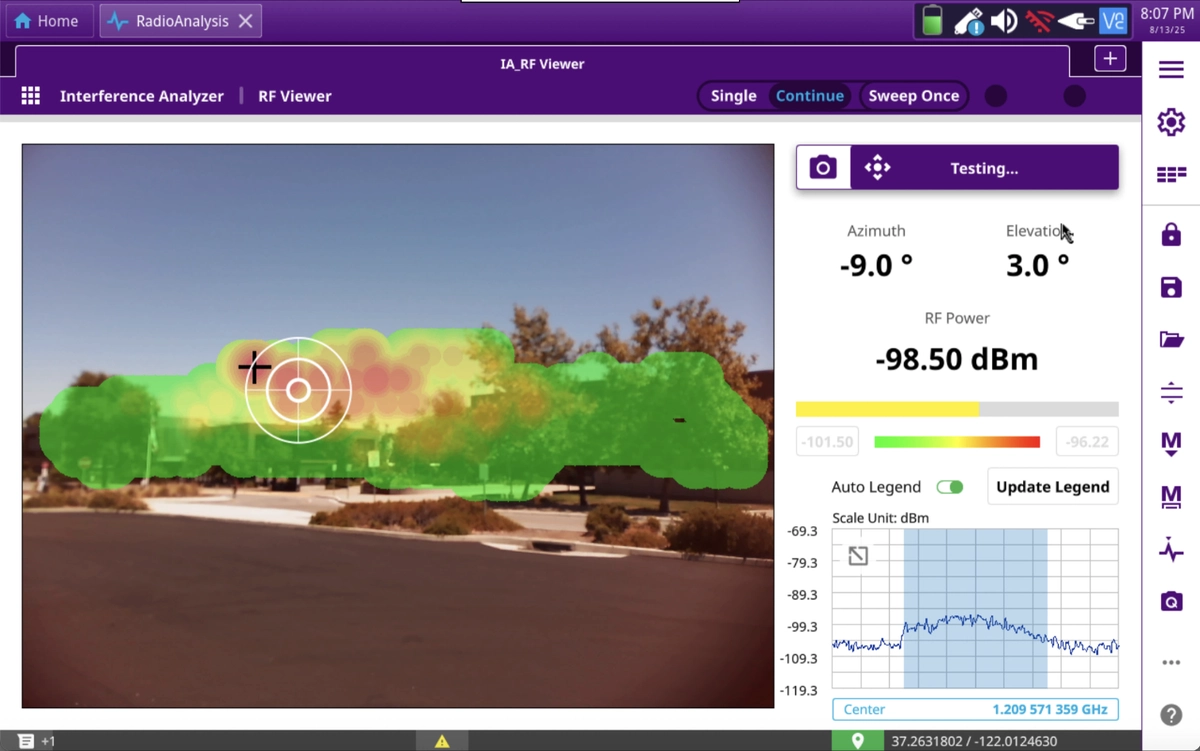
As the heat map is a real-time diagnostic overlay rather than a post-processing visualization, it becomes immediately possible to identify the primary interference source, with no interpretation required and no back-and-forth between the instrument display and physical environment.
This direct visual feedback transforms interference resolution from a multi-hypothesis troubleshooting exercise into a deterministic location task. Customer reports have recorded significant improvements in MTTR for RF Viewer versus traditional PIM and interference hunting methods, which is driven primarily by increases in first-visit resolution rates.
OPEX reduction and risk mitigation
From a network engineering management perspective, the RF Viewer delivers three measurable outcomes that extend beyond individual technician productivity.
- Reduced truck-roll and associated costs:Every avoided repeat visit translates directly to lower operational expense. For a typical service provider managing thousands of cell sites, even a modest reduction in multi-visit cases will lead to annual savings for labor, vehicle costs, and site access fees that reach into hundreds of thousands of dollars.
- Improved revenue protection and uptime:Having degraded service quality for extended periods due to unresolved RF interference issues directly impacts customer experience. In competitive markets, this increases churn rates. For defense and public safety networks, which have mandated uptime requirements, interference can disrupt secure communications or emergency response coordination. Take, for example, a fire department operating a FirstNet, P25, or TETRA network to coordinate responses during wildfires. Here, interference resolution is not just about quality of service (QoS) metrics, but about operational readiness. Interference in a coverage area can become a public safety failure, not merely a technical inconvenience. RF Viewer ensures that interference events are resolved correctly the first time.
- Lower safety risk and liability:Climbing onto a rooftop or up a tower is a high-risk activity. Every additional climb to re-investigate an unresolved interference case increases exposure to falls, weather hazards, and fatigue-related incidents. Reducing repeat visits reduces cumulative safety risk for field personnel and lowers organizational liability.
Integrating RF Viewer into Existing Workflows
RF Viewer has been developed to work alongside VIAVI OneAdvisor 800 spectrum analyzers. The solution integrates into standard interference hunting workflows without requiring new test access points, software platforms, or backend integration.
For defense contractors and military network operators, where equipment interoperability and supply chain validation are critical, RF Viewer’s field operation model ensures it can be deployed without creating integration dependencies or certification delays.
RF Viewer operates in real time with no post-processing lag, enabling technicians to work efficiently even in time-constrained maintenance windows — overnight access slots, scheduled outages, or emergency response scenarios where every minute of diagnostic time is accounted for.