AI RAN Scenario Generation and the RAN Digital Twin

It is rush hour in a busy city center. Thousands of smartphones are moving between cells as commuters leave offices and head home. Across the network, an AI-powered xApp is making real-time decisions about which radios can be powered down to save energy, and which need to remain fully active to handle demand. These decisions happen automatically in milliseconds.
That is the promise of AI in the Radio Access Network (RAN), but it is also presents a challenge. What happens if an algorithm makes the wrong decision just as network traffic suddenly spikes?
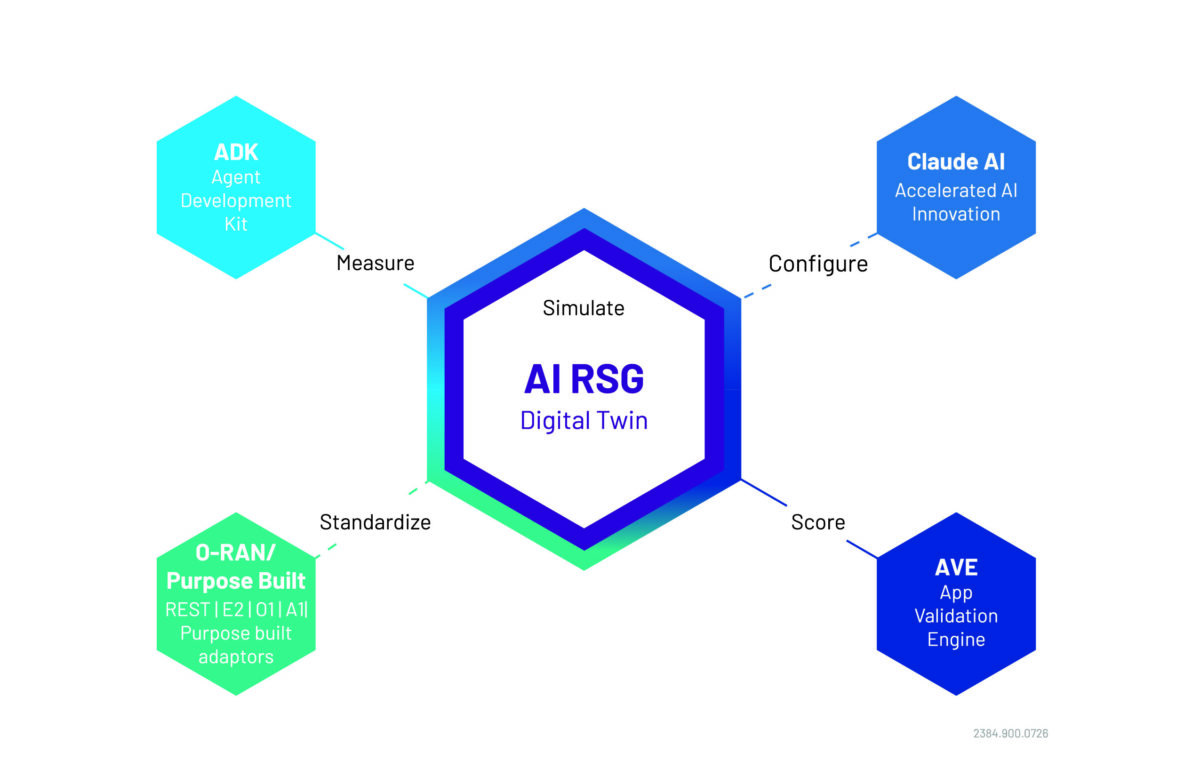
The VIAVI TeraVM AI RSG (AI RAN Scenario Generator) provides a safe environment where AI-driven RAN applications can be trained, tested and validated before they are deployed into live networks.
The platform combines high-fidelity RF simulation, realistic 3D ray tracing, site-specific field data and hybrid datasets that blend synthetic and real-world network behavior. The result is a digital twin that enables teams to understand exactly how AI applications will perform under real operating conditions.
AI RSG can model dense urban environments with thousands of users, cells and constantly changing traffic conditions. Alongside this, the VIAVI App Twin ADK provides a Python-based development environment where engineers can rapidly build and test AI applications for RAN networks.
What AI RSG Does
AI RSG delivers capabilities that go far beyond traditional network simulation.
Large-Scale Scenario Generation
The platform can emulate thousands of user devices and network cells, along with moving vehicles, subscriber activity and changing traffic patterns. This allows AI models to be tested under realistic conditions at scale.
Anomaly Injection and Closed-Loop Validation
Engineers can introduce controlled faults and unusual network conditions to evaluate application resilience. The App Validation Engine (AVE) compares rApp and xApp decisions against baseline models and measures their impact on key performance indicators (KPIs).
Hybrid Data for AI Training
Synthetic datasets are enriched with historical and live network KPI trends. This gives AI models exposure to both realistic variability and real-world network behavior during training and validation.
High-Fidelity RF Digital Twin
AI RSG combines advanced ray tracing with field measurements to create an Air Interface Digital Twin that accurately reproduces propagation, mobility and interference conditions. This supports both over-the-air and digital interface testing.
The Building Blocks
The solution consists of four key components:
- TeraVM AI RSG: Generates realistic network scenarios, user behavior and traffic patterns for AI training and validation.
- Air Interface Digital Twin: Provides a high-fidelity RF environment calibrated with real-world field measurements.
- App Twin ADK: A Python-based development environment where engineers can build, test and deploy AI applications and simulation workflows.
- App Validation Engine (AVE): Measures application performance against baseline models, scores results and supports iterative optimization through closed-loop testing.
One Platform, Different Users
Different teams use AI RSG for different reasons, but all share the same objective: finding and fixing issues before deployment.
Network Equipment Manufacturers (NEMs)
NEMs use AI RSG to validate AI features, certify interoperability, and reproduce field issues in a controlled lab environment.
They can test interactions between AI models and vendor platforms, verify security and safety requirements and benchmark AI-driven behavior against traditional RAN operation.
The result is faster certification, reliable regression testing and reduced deployment risk.
Operators and Service Providers
Operators use AI RSG to evaluate deployment risks, optimize network performance and protect service-level agreements.
Field-calibrated digital twins allow teams to test energy-saving strategies, traffic steering, interference mitigation and network slicing before making changes in production networks.
This reduces the need for costly field trials while improving KPIs and accelerating deployment.
rApp and xApp Developers
Developers can create digital versions of production applications, train models and benchmark performance using AVE.
By combining synthetic data, historical KPI trends and anomaly injection, developers can build more robust models and reduce time to market.
The outcome is faster development cycles and measurable performance improvements.
Research Institutions and Standards Bodies
Researchers can evaluate new AI techniques, RAN algorithms and network architectures using controlled, repeatable environments.
This enables faster experimentation, more consistent benchmarking and reduced dependence on expensive field testing.
Defense and Government Organizations
Defense and government teams can evaluate mission-critical 5G deployments, tactical networks and resilience against degraded communications scenarios.
Secure, air-gapped testing environments provide confidence before deployment and help improve mission readiness.
How Testing Works
Every project begins with a baseline. Engineers upload network configurations, site information and performance data into the App Twin ADK. AI RSG then generates targeted scenarios, including urban congestion, mobility events, interference conditions and network anomalies.
These scenarios become training and validation datasets for AI applications running within the development environment.
The App Validation Engine closes the loop by comparing application decisions against benchmark models and measuring KPI improvements. Teams can refine and retest their models until target performance levels are achieved.
Typical closed-loop testing programs demonstrate 10-20% KPI improvements against targeted objectives, alongside measurable gains in energy efficiency and network throughput.
Part of Something Bigger
TeraVM AI RSG and App Twin ADK transform expensive and risky field testing into a repeatable, data-driven process.
For network equipment vendors, it supports certification and regression testing. For operators, it reduces deployment risk and enables network optimization. For application developers, it provides a rapid feedback loop that accelerates innovation.
AI RSG is also a foundational component of VIAVI’s Generative Reality Digital Twin™ (GRDT), a federated digital twin framework that creates high-fidelity, real-data-calibrated models of live networks across RAN, IP, transport and other domains.
At its core is a simple principle: AI should test AI before AI makes decisions in a live network.
Back in that busy city centre, the xApp is still making decisions in milliseconds. The difference is that those decisions have already been tested thousands of times inside a digital twin that accurately predicts how the real network will respond, long before a single subscriber is affected.
Watch for the next post in this series: the autonomous network journey, and how AI RSG helps build a RAN that can watch itself, decide for itself, and act on itself. We’ll go deeper on use cases, workflows, market evidence and how to get started. Stay tuned.