Accelerating AI-Native Networks with NVIDIA AI-RAN Platforms
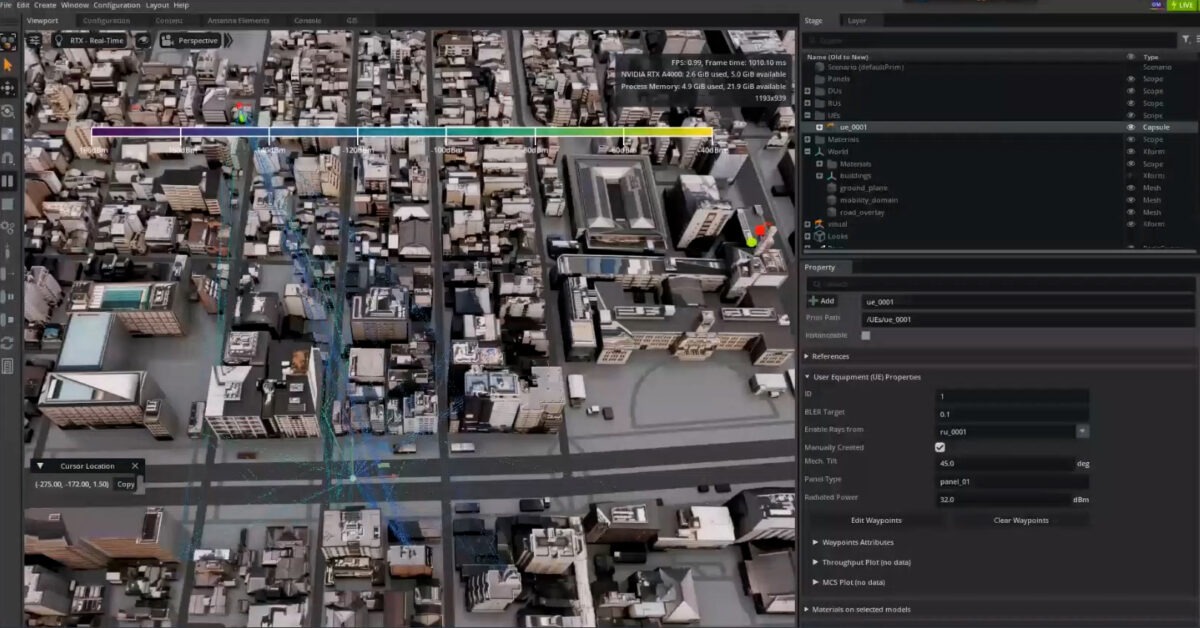
As MWC Barcelona 2026 approaches, VIAVI and NVIDIA are deepening our collaboration with work centering on the AI-native Radio Access Network (RAN) and autonomous networks. At the show, VIAVI will present a series of joint demonstrations, built on NVIDIA AI-RAN platforms, that highlight our shared vision of how advanced simulation, accelerated computing and AI can transform radio access networks and the way they are designed, tested and optimized.
These demonstrations bring together VIAVI’s leadership in RAN testing, validation and real-world network data with NVIDIA’s expertise in accelerated computing and AI-RAN platforms. Both companies play key roles in advancing open and AI-native network standards and blueprints through the O-RAN Alliance, AI-RAN Alliance and OSA, and this alignment ensures customers benefit from interoperable, future-proof solutions shaped by a collaborative global ecosystem.
Several demonstrations will be held at VIAVI’s booth 5B18 in collaboration with NVIDIA, spanning:
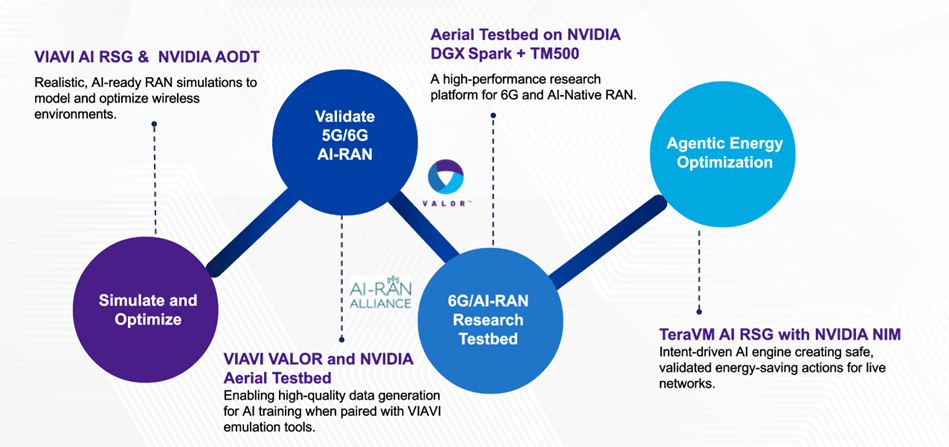
- Agentic RAN Digital Twins: Combining VIAVI’s TeraVM AI RAN Scenario Generator (AI RSG) with NVIDIA Aerial Omniverse Digital Twin (AODT) and ray-tracing for realistic, cloud-scale RAN simulations on AWS.
- AI-Native RAN Development: Integrating NVIDIA AI Aerial platform and VIAVI’s TM500 to build, test and validate intelligent RAN functions.
- 6G/AI-RAN Research Acceleration: NVIDIA Aerial Testbed running on NVIDIA DGX Spark, Aerial L1 and OAI L2 + TM500 creating a powerful testbed for academia, network equipment manufacturers (NEMs) and mobile network operators (MNOs) exploring 6G-ready architectures.
- Energy-Efficient Networks: Joint blueprint for intent-driven AI that reduces RAN energy consumption while protecting service quality.
These platforms will showcase the benefits of our joint approach in terms of innovation cycles, operational costs and network performance, as well as highlight how these advances can be adopted to implement a truly AI-optimized RAN.
Agentic RAN Digital Twins
VIAVI and NVIDIA have created a realistic, scalable RAN simulation tool specifically for AI development.
In this demonstration, VIAVI’s TeraVM AI RSG has been combined with NVIDIA Aerial Omniverse Digital Twin (AODT) to create highly realistic, AODT-compatible RAN scenarios rendered with NVIDIA’s ray-tracing technology. As you can see in Figure 2, this creates an incredibly accurate integrated environment that allows for detailed, scalable RAN simulations on AWS and enables vendors and researchers to use real (rather than assumed or best-case) network data and AI/ML to optimize network performance with confidence.
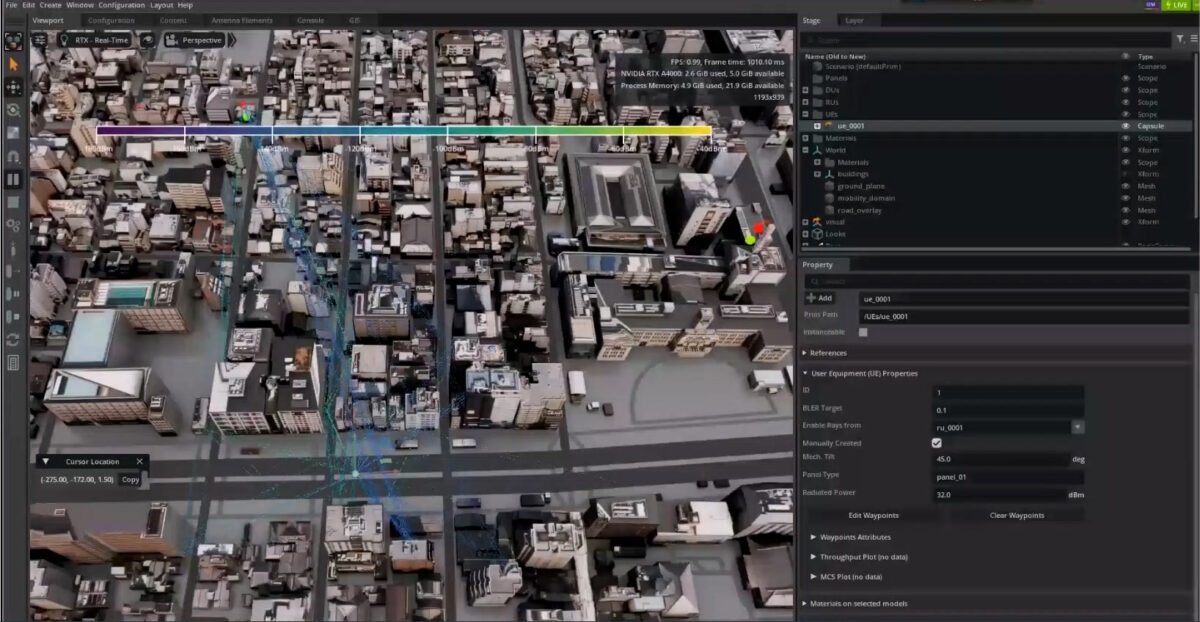
AODT is calibrated with field measurements from the VIAVI OneAdvisor 800 Wireless, creating highly accurate digital twins of customer cell sites and producing the most valuable datasets for machine learning and AI-driven RAN optimization.
AI-Native RAN Development: 5G Ghost Preamble Challenge
The 5G ghost preamble challenge occurs when noise is misidentified as a valid user preamble. The result of this misidentification is that unnecessary connection attempts can be triggered, and network capacity can be reduced.
Through our partnership with NVIDIA, as well as with the AI-RAN Alliance and GlobalLogic, we will showcase a deep-learning model that can accurately distinguish genuine user equipment access requests from phantom signals and maintain strict L1 timing.
The demonstration uses NVIDIA Aerial Testbed set up in the VIAVI Automated Lab-as-a-Service for Open RAN (VALOR™) Lab. VALOR is funded by the U.S. National Telecommunications and Information Administration (NTIA) Public Wireless Supply Chain Innovation Fund.
6G AI-RAN Research Testbed
For those working in academia, as well as NEMs and service provider research groups, we have created a 6G AI-RAN Research Testbed.
By combining Core emulation, NVIDIA Aerial tested on NVIDIA DGX Spark, Aerial L1 and OAI L2 hosted gNB and TM500 O-RU/UE emulator within VALORs, we’re addressing use cases that include AI‑native PHY, channel state information (CSI) and feedback, radio resource management, novel architectures, energy efficiency, and other emerging topics.
Agentic AI Blueprint for Energy-Efficient Networks
While 5G is up to 90% more efficient at transferring data (bits per kW), the sheer flow of data running across the network means they are still expected to account for over 1% of the world’s electricity production by 2030. Continuing this Jevons Paradox, 6G will similarly lead to yet more gains in efficiency per bit transferred, but again these savings will be undone by the continued increase in data moving across these networks. The RAN accounts for more than 70% of total network energy consumption, and it’s vital that every step is taken to reduce this consumption.
Leveraging AI models and agents represents a novel approach in achieving this goal, and at MWC we have worked with NVIDIA to create a blueprint for intent-driven energy savings on 5G networks.
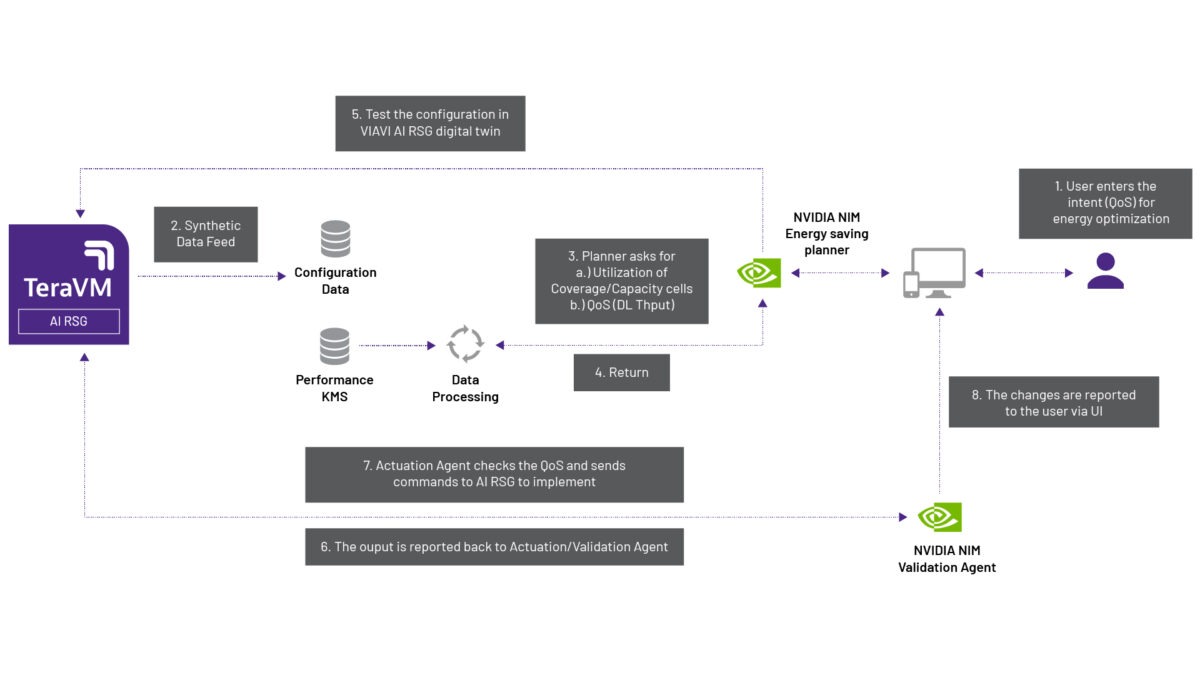
Visitors to the booth will see how this has been implemented, starting with the operator expressing the high-level energy savings goals using natural language, with the planner agent evaluating real network conditions simulated by AI RSG RAN digital twin to identify and recommend the safest optimization strategies. The energy savings recommendations – i.e. which cells to be turned up (wake) or down(sleep), when and for how long – will then be validated by the actuation agent inside the AI RSG before they are activated on the simulated network.
The blueprint uses an LLM for high-level reasoning, while also maintaining transparent, auditable decision logic throughout the process.
You can download the blueprint here and see it in action during the Agentic AI Tech Masterclass hosted by NVIDIA.
Schedule a meeting with us at MWC 2026 to get a deep dive into these exciting collaborations with our partner NVIDIA, and many more. Book your slot here.