Demonstrating AI-Driven Network Control for 6G

As we recently announced, VIAVI and NTT DOCOMO INC. have successfully completed a joint study demonstrating AI-driven radio access network (RAN) control for next-generation 6G mobile communications.
The demonstration was conducted in a simulated environment modeling multiple base stations around the Tokyo Station area. Predictions were enabled by the TeraVM AI RAN Scenario Generator (AI RSG), with measurements generated by the digital twin.
In this blog, we provide a deeper dive into this groundbreaking study, which shows that the Self-awareness Network concept from DOCOMO significantly reduces the need for conventional network quality measurements and UE reporting. In addition, intelligent technologies such as tailored network digital twins and AI-powered simulators based on high-quality, trusted, real-world data enable highly efficient network control.
The results will be showcased at VIAVI’s Stand 5B18 at Mobile World Congress (MWC) Barcelona 2026, which takes place March 2-5 in Barcelona, Spain.
DOCOMO Self-awareness Network
The Self-awareness Network is a technology proposed by DOCOMO to realize one of its key 6G values: “AI for the network.” By leveraging AI and digital twin technologies, the Self-awareness Network aims to improve network performance and efficiency, such as control-overhead reduction, across diverse radio environments.
Specifically, network quality is evaluated within a digital twin environment using data such as location information and radio propagation characteristics. Network control is then performed based on these evaluation results. This approach significantly reduces the need for conventional network quality measurements and reporting by user equipment (UE), enabling highly efficient network control and at the same time improving the spectrum efficiency.
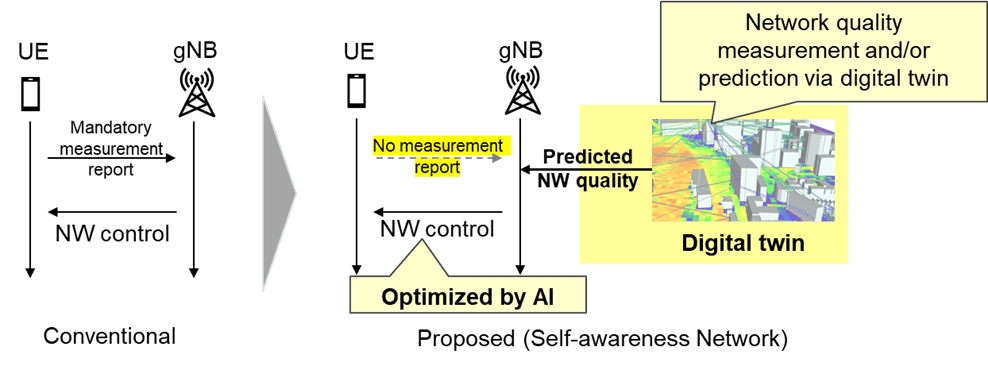
Base Station Beam Control Based on the Self-Awareness Network
In conventional beamforming, base stations select and control transmission beams based on network quality measurements reported by user devices. This study demonstrates the efficiency gains achieved by leveraging AI-based network quality prediction, thereby reducing the frequency of UE measurement and reporting.
The demonstration was conducted in a simulated environment modeling multiple base stations around the Tokyo Station area. Each base station selects the optimal beam for each UE from eight candidate beams based on network quality.
In the conventional method, beam selection is based on UE-reported network quality measurements. In the proposed method, the frequency of UE measurements and reports is reduced, and beam selection is instead performed by combining AI-based predictions with network quality measurements obtained from the digital twin. Measurement obtained from the digital twin is used for training, or as input to AI model inference.
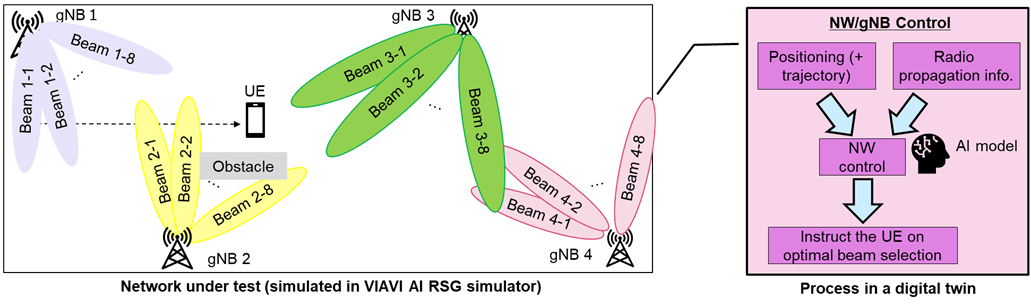
In the study, VIAVI evaluated the Self-awareness Network concept using its digital twin and TeraVM AI RAN Scenario Generator (AI RSG) network simulator.
The proposed method was confirmed to achieve optimal beam selection compared to the conventional approach. Furthermore, by reducing radio control overhead, the proposed method achieved approximately 20% uplink throughput improvement. These results confirm that the use of digital twin and AI technologies can significantly reduce the frequency of UE network quality measurements and reporting, reducing control overhead.