OFC 2026: 1.6T Going Mainstream & the Emergence of 3.2T
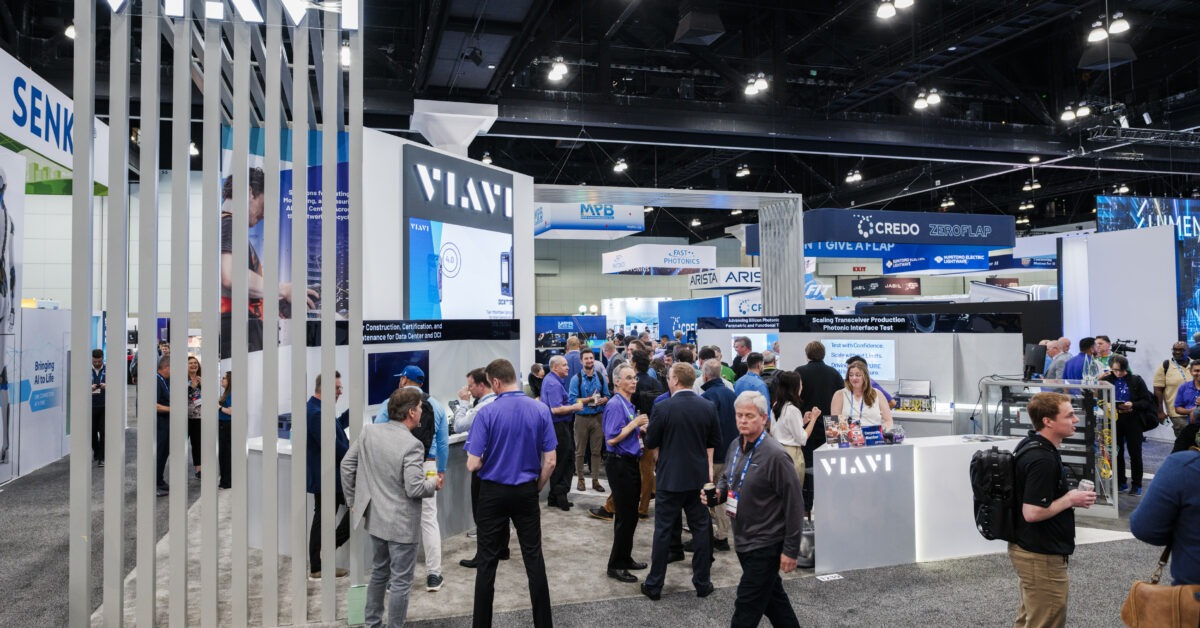
2026 is shaping up to be a defining year for the optical networking industry, as evident at OFC. Notably, it highlighted the ongoing convergence of multiple technologies that, when coupled with the rise of AI-native networks, means traditional throughput tests are no longer sufficient to guarantee a network can handle synchronized AI compute efficiently, reliably, and at scale.
One of the biggest takeaways of the show was the industry scaling to 1.6T. To manage the increasing traffic and meet demand, optical networks must scale in three dimensions:
- Scale out, by adding more links to connect GPUs, servers, racks, switches, and fibers
- Scale up, by increasing bandwidth per link
- Scale across, by reducing latency to improve overall fabric efficiency
What we saw at OFC was the demonstration of mainstream products that scale into multi-terabits and enable interoperability across several vendors, while still meeting the needs of standards and MSAs. As a leader in test and measurement for over 100 years, and leveraging deep connections with customers, partners and industry bodies, VIAVI is well positioned for this transition. The company was the first to market in 2024 with its ONE LabPro® ONE-1600 1.6T validation module, and at OFC added the next generation TestCenter D2 1.6T Appliance to our validation offering.
Looking Beyond 1.6T: Preparing for 3.2T
Even as 1.6T gains momentum, VIAVI and many others in the industry are already planning for the arrival of 3.2T. A key inflection point, 3.2T will drive new optical architectures and form factors while significantly increasing system-level and testing complexity. While there are large technology barriers to achieving 3.2T, it would be a safe bet to expect initial live demonstrations in 2027.
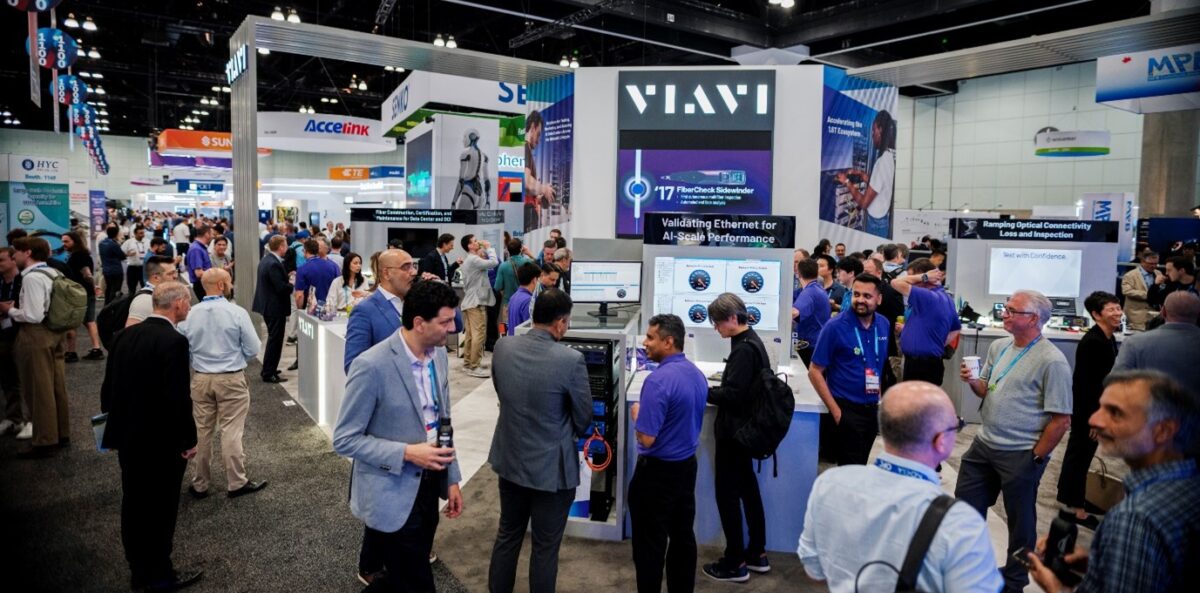
Key Technology Trends at OFC 2026
The migration from 800G to 1.6T and preparation for 3.2T were only part of the story. OFC also showcased a wide range of engineering approaches aimed at delivering higher bandwidth, lower power, improved cooling and better density. These included innovative form factors such as XPO, ELSFP, NPO, and CPO.
Other notable trends included:
- Optical circuit switches supporting more agile GPU interconnect architectures in hyperscale data centers
- Multi‑rail line systems using coordinated parallel paths to enable geographically distributed data centers to operate as a single compute and storage domain
- PCIe 6.0 over optics, extending low‑latency PCIe® connectivity across racks and data‑center distances
Last but not least, silicon photonics arguably underpins all of the above and will play a crucial role in the shift to 3.2T. It is the enabling technology that will allow bandwidth to scale while keeping power, size, and cost under control.
At the VIAVI booth, test platforms such as the MAP 300 test platform drew particularly strong interest, with demonstrations showing how its modular architecture, photonic integration, high density, and throughput gains help manufacturers scale production with greater efficiency.
Similarly, the new Data Center Expert (DCX 700) also saw considerable interest, with the critical test tool for multifiber networks inside the data center taking a prominent role alongside solutions for Hollow Core Fiber (HCF) testing and a new Distributed Acoustic Sensing (DAS) solution with embedded AI/ML.
Introducing VIAVI TestCenter D2 1.6T Appliance
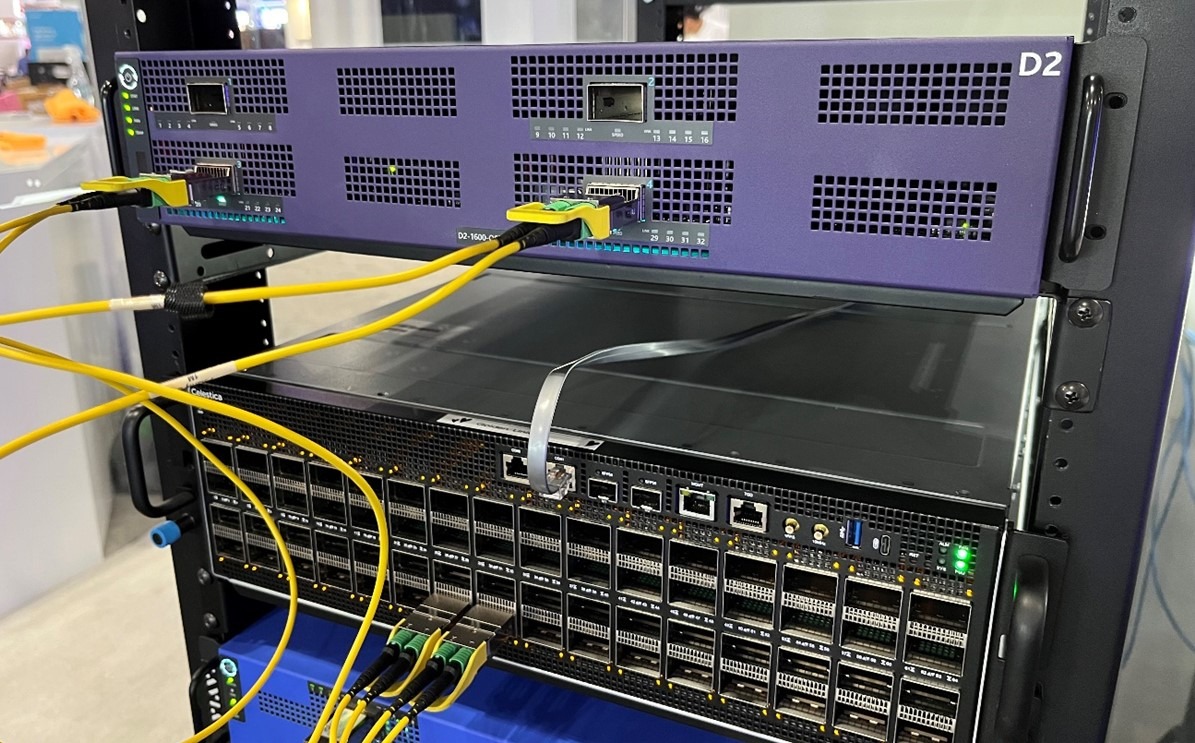
One of the stars of the show was the new TestCenter D2 1.6T Appliance, which was unveiled at OFC. Designed for high-density, multi-rate Ethernet testing, the platform delivers deep Layer 2–3 protocol analytics, with deterministic, repeatable, and scalable validation for multi-terabit environments.
It is purpose-built to validate AI data centers, neo-clouds, service provider infrastructures, and high-capacity network devices using up to 1.6T Ethernet. It achieves this through the generation of complex, realistic traffic patterns that emulate demanding AI workloads, including RoCEv2, CCL and Ultra Ethernet Transport (UET) flows with congestion control. This includes sustained full-load operation, long-duration traffic runs, and protocol stress testing, enabling comprehensive validation of high-capacity switches, routers, fabrics, and congestion-control mechanisms.
Validating Across Layers 0-3
The launch of the TestCenter D2 1.6T Appliance follows the acquisition of Spirent’s High-Speed Ethernet, Network Security and Channel Emulation (HSE/NS/CE) business in October 2025 and builds on the expertise of both companies.
It is complementary to VIAVI ONE LabPro ONE-1600ER test module for deep PHY Layer to Layer 2 testing. Launched last September, the ONE-1600ER provides full Ethernet support as defined in the latest IEEE 802.3dj specification including 1.6TE MAC, 2x800GE, 4x400GE, 8x200GE and full FEC support, which is essential for testing, analyzing, and exercising 200G lanes at 224G SerDes. ONE-1600ER also supports 100G lanes based on 112G CEI SerDes and unframed testing. It delivers four comprehensive RFC tests covering RFC 2544/5180/2889/3918 for full benchmark testing. It also offers ILT inner sublayer link training, LT for DAC cables, and symbol muxing introduced in 802.3dj.
Leading the Industry
 Test and measurement vendors need to be ahead of technology, testing and developing it at the same time – and VIAVI is at the forefront. Indeed, for the tenth consecutive year, VIAVI’s industry and technological leadership were recognized at the Lightwave Innovation Awards ceremony, with six trophies presented on the night.
And with a comprehensive solution set, VIAVI is becoming a trusted partner in the ecosystem, bringing next-gen technologies like 1.6T and 3.2T to reality.
Learn more about validating high-speed Ethernet infrastructure and network services.