ECOC 2026 Shows Need for Cohesive, End-to-End Test and Measurement Frameworks
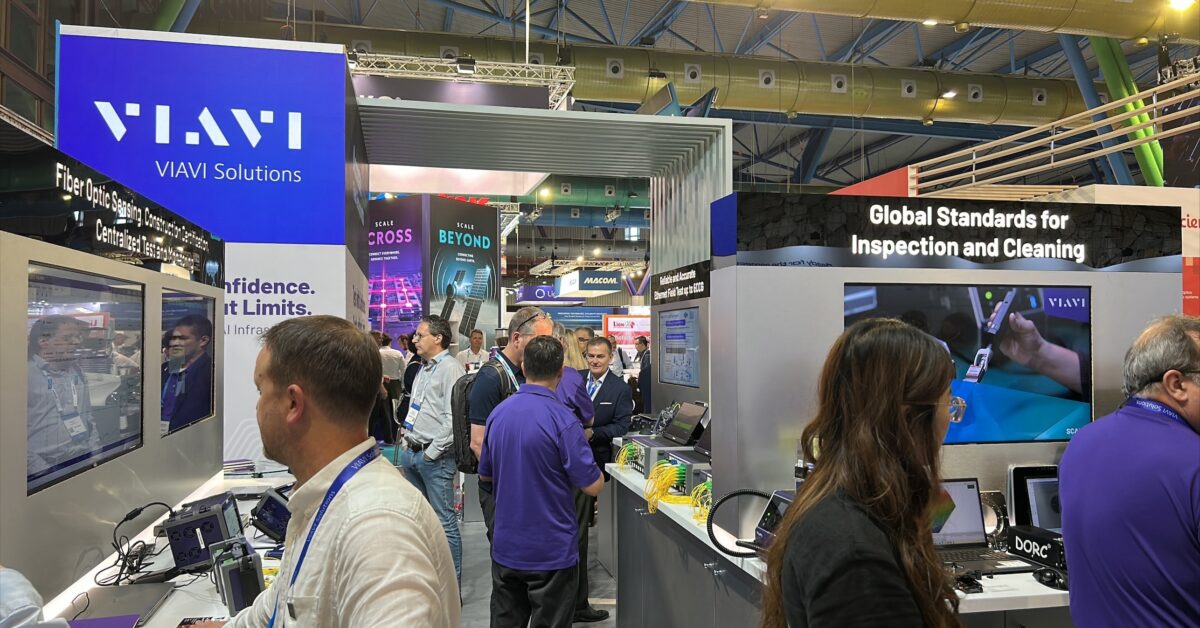
Advances are taking place across a wide range of technologies. At ECOC 2026, we saw leaps forward in high-speed Ethernet (HSE), co-packaged optics (CPO) and silicon photonics (SiPh), along with fiber density, multifiber technologies, and alternative designs such as hollow-core fiber (HCF), alongside advances in peripheral but critical systems like quantum security.
This is driving system complexity up rapidly across scale-up, scale-out, and scale-across infrastructure, making testing essential at every stage. 1.6T (and soon 3.2T) deployments accelerating across hyperscale AI infrastructure was a prominent theme at ECOC 2026, with VIAVI highlighting testing solutions for each stage.
Design and Validation
The move to 224G-per-lane SerDes over PAM4 is degrading eye openings and raising jitter/crosstalk risk, demanding deep physical-sublayer diagnostics on 224G SerDes link training, FEC symbol multiplexing, and thermal behavior under IEEE 802.3dj. The VIAVI ONE-1600, which now includes a RHS/IHS combo module, provides multi-port 1.6T physical-layer analysis with nanosecond latency tracking to validate these characteristics.
For 1.6T AI workloads, Ultra Ethernet raises the stakes on tail latency, microburst management, and congestion control during traffic bursts. The TestCenter D2 1.6T Appliance addresses this with UEC conformance suites and RoCEv2/CCL/UET performance testing.
PCIe over Optics is gaining traction as a high-speed interconnect technology for AI data center scale-up applications. VIAVI showcased its Xgig PCIe 6.0 platform at ECOC26 in a demonstration analyzing PCIe traffic over a Macom optical link and an endpoint DUT from Qualcomm.
Manufacturing and Production
Taking 1.6T transceivers, silicon photonics, and high-density connectors into volume production raises the stakes on throughput and yield. Surface defects and geometric misalignments can degrade a multi-fiber interface’s optical power budget and compromise cluster reliability if undetected. The VIAVI ONE-1600ERP is a physical layer test solution for pluggable 1.6T and 800G Ethernet transceivers purpose-built for manufacturing and production test.
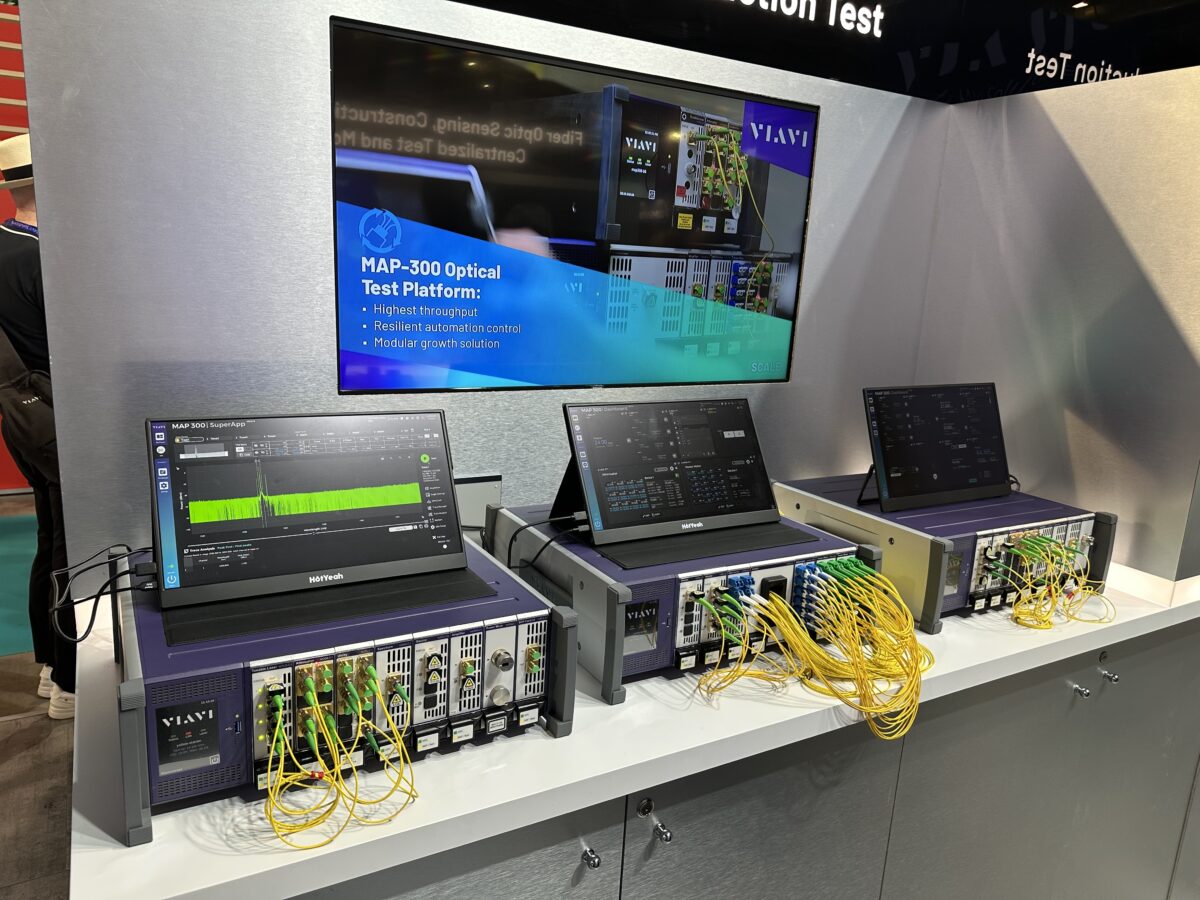
The MAP-300 platform, with its remote head polarity mapper, high-density VOA, and optical power meters, serves as the manufacturing test backbone for optical subsystems and co-packaged optics/silicon photonics. VIAVI’s acquisition of the Direct Optical Research Company (DORC) product line adds 3D optical interferometry for end-face and surface verification across dense MPO/MMC connectors, expanding VIAVI’s best-in-class solutions for optical connectivity testing.
Deployment and Monitoring
The next phase is field installation, deploying the components in data centers and across data center interconnect (DCI) links. At this phase, the operational challenges relate to scale, speed, and physical interface integrity, with significant spatial constraints that require certification for optical continuity, polarity, and insertion loss across dense MPO and very small form factor (VSFF/MMC) patch panels.
At the same time, data centers are also looking to install the emerging hollow-core fiber (HCF) technology for its low-latency optical propagation. This too brings additional challenges, with the need for specialized OTDR, chromatic dispersion testing and custom backscatter interpretation algorithms. For a more detailed view of these challenges than this blog allows, you can download our free whitepaper here.
In addition to solutions such as the DCX 700, the required OTDR analysis for HCF can be undertaken through platforms such as the T-BERD/MTS-4000 and the OneAdvisor Fiber platform, which are available with custom algorithms for interpreting the novel backscatter patterns that are apparent in HCF links.
After infrastructure goes live, the need to maintain continuous link assurance and strict SLAs across high-speed DCI routes becomes the focus for test and measurement strategies. The verification systems also need to take into consideration the small size of on-site teams in a hyperscaler, with significant levels of automation put in place.
VIAVI has recently introduced the MAP-2800 test head for standalone operation and centralized testing with the Fusion test system for Layers 2-4. The platform is the industry’s first rack-mounted tester for Ethernet applications across centralized and field testing from 10M to 800G and has been created to automate processes in lower bandwidth sites to remove testing bottlenecks and minimize truck rolls.
Security
Quantum computing is advancing quickly, and harvest-now-decrypt-later strategies threaten data flowing through hyperscalers, forcing a reassessment of physical-layer security. QKD is being deployed alongside hybrid networks, but poor implementation can create issues, making QKD link/stress testing essential before go-live.
QKD evaluation at the photonic layer has been optimally integrated into the MAP-300 platform. Additionally, CyberFlood, VIAVI’s network security test platform, offers advanced quantum-safe (PQC) cryptography testing for cipher suites and performance as networks move to post-quantum encryption. More on quantum-threat validation is available here.
Conclusion
As data center architectures scale to 1.6T and beyond, isolated point testing no longer guarantees cluster reliability and uptime. A cohesive, end-to-end test and measurement framework, from lab design through manufacturing, deployment, monitoring, and security validation, is the only way to safeguard optical infrastructure performance while scaling without limits.