VIAVI’s AI-First Solutions Approach

AI is a foundational force reshaping every industry. This is especially true for many of the sectors VIAVI serves.
From communications networks to critical infrastructure, from aerospace to defense, and from data centers to optical sensing, systems are becoming too complex, too dynamic, and too mission-critical to be managed by traditional methods alone.
In this blog, we outline how we use AI, how our tools and services implement it, and how our technology platforms enable it for others.
Generative Reality Digital Twin™ (GRDT)
One of the most significant roles AI has to play is in the management of highly complex networks.
For example, 6G will incorporate new bands (FR3) and features (ISAC). Multi-vendor Open RAN stacks, non-terrestrial networks and beamforming will be commonplace. This complexity requires AI algorithms and agents to manage and optimize these networks.
These agents must cope with any situation and maintain exceptional throughput and low latency. This includes the ability to cope with fringe and exceptional traffic patterns not seen before on live networks. Modeling and stress testing before implementation is therefore essential.
Digital twin network replicas enable testing and validation; however, the added complexity of 6G amplifies the law of unintended consequences. All networks are constrained by highly complex physics and by interactions between internal and external elements. As such, even a small change, for example, to improve efficiency or coverage in a section of the network, can have unanticipated detrimental effects on performance, QoE, and interference with other sections and elements of such a network.
For 6G and similarly complex networks, digital twin models need to be near-perfect replicas and fed with high-fidelity, live, real-time data. They also need to be a complete, federated representation of all domains on the network: the RAN, the IP transport, the core, the RF, and the non-terrestrial network elements, all validated against a single shared body of data. And crucially, they need to be generative: using AI to create new conditions and to understand how the network will behave when faced with never-seen-before stress or attacks.
This is the principle behind VIAVI’s Generative Reality Digital Twin™ (GRDT), an AI-first approach to model virtually any traffic or system change to identify and eliminate or minimize risks.
VIAVI GRDT is a federated, high-fidelity digital twin of a live network. It federates domain-specific digital twins — RAN, IP/Transport, and more — each continuously synchronized with real network data in real time. AI tests AI inside GRDT before any change touches the live network.
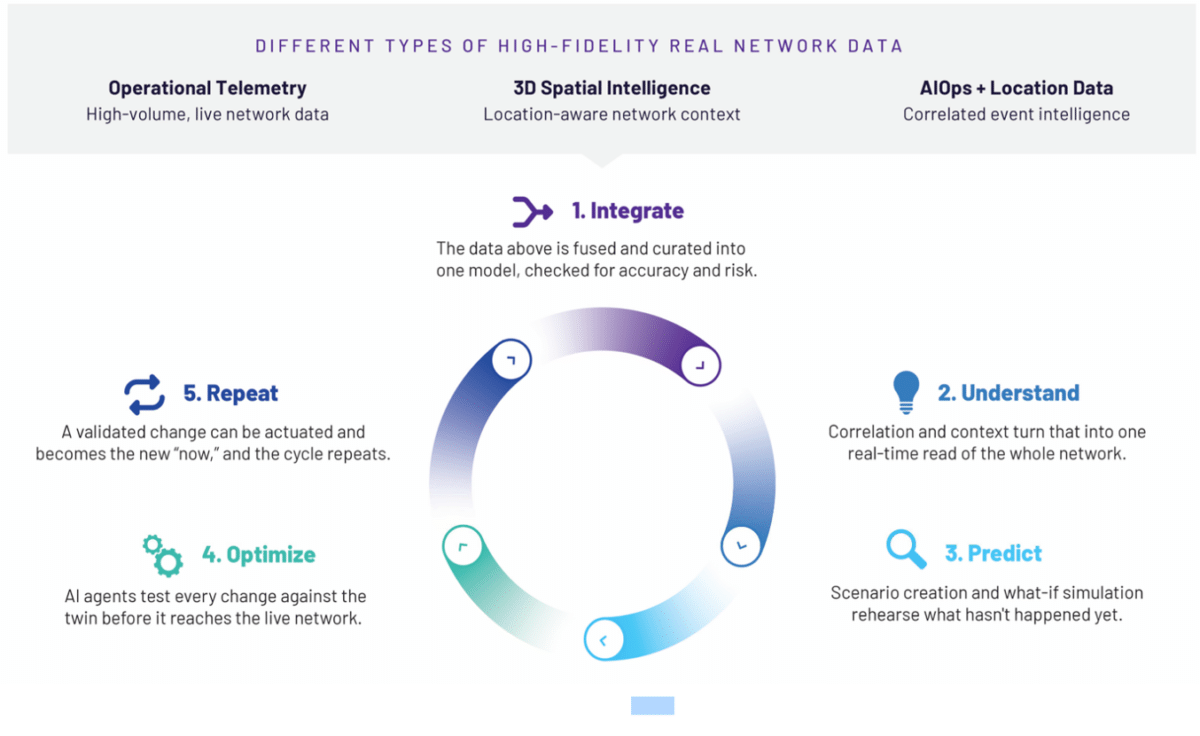
GRDT encapsulates domain-specific twins – RAN, IP/transport, and the 3GPP core – behind a single, federated validation layer with the purpose-built domain twins underneath, so a proposed change is checked against its effect on the whole network, not just the segment where it originates.
Domain twins still matter, and they still need to be built for the physics of their own domain. IP and transport networks are graph-structured systems (topology, routing tables, traffic matrices) where graph neural networks and algorithmic and simulation twins reconciled against each other are the right tool, as we’ve covered in a previous blog: Graph Neural Networks and Digital Twins: The Path to Autonomous IP Transport – VIAVI Perspectives
The same is true for RAN simulation digital twins and those for emerging 6G environments.
A key generative element of the GRDT is VIAVI’s TeraVM AI RAN Scenario Generator (RSG), which applies AI to create city-scale networks or generate real-world usage patterns. Changes introduced can extend beyond threats and stresses to answer questions such as:
- What happens if I remove/add a mast or NTN element?
- Will an emergency shutdown of a set of masts – for example during a fire – create cascading system overloads on neighboring masts, and what steps are needed to prevent them?
- Will an altered power profile affect QoE?
- Will a planned skyscraper/road/housing development affect signal propagation? How can this be managed?
By constantly undertaking testing, AI RSG can be used to understand and mitigate performance drift occurring in the xApps and rApps that are being used to control next-generation networks. For example, this is taking place on the European SUNRISE-6G platform, which uses an open-source digital twin of real-world networks to benchmark the apps and is now in the trial phase.
Similar digital twin projects of note include a city-scale 6G network by Northeastern University and NTT DOCOMO’s evaluation of beam selection methods for self-aware 5G and 6G networks.
As we’ve highlighted, the costs of 6G rollouts mean networks need to be tested against an accurate depiction of the real world. But as no network currently exists, we need to go beyond simple emulation. Any testbed needs to take a view of the network from three angles: the live network view, the spatial view, and the field view.
For this, we have VIAVI’s GPU-Powered Real-Time 6G Testbed, an advanced platform that enables theoretical 6G concepts to be validated under real-world conditions and gives trust ahead of full-scale deployment.
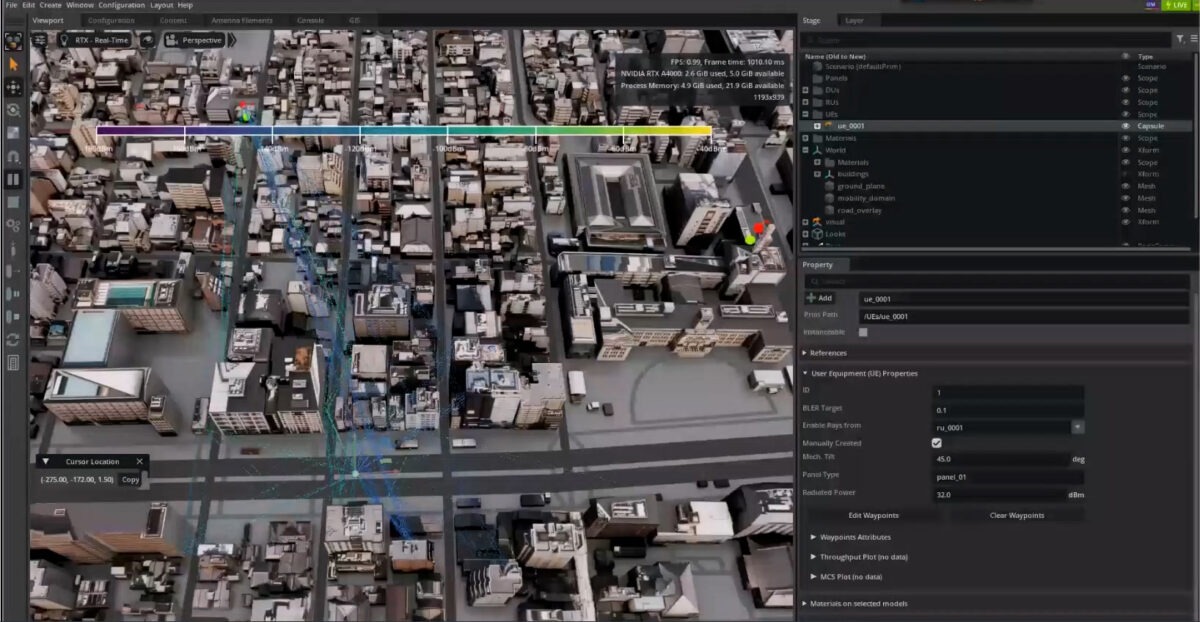
For an operator, this means every change recommended by a network performance and security management AI is safe before it is applied. But it applies across the ecosystem too, with network equipment manufacturers able to test AI features and interoperability across every supported vendor before shipping, as well as allowing chipset developers and OEMs to validate beam coverage and interference at scale ahead of tape-out.
However, the use of GRDT extends well beyond 6G validation. The technology is also being used to ensure optimal performance of data center fiber optic networks. Here, it enables networks to be optimized for the bursty east-west traffic patterns that are seen during training, and an understanding of how the network handles the traffic jams that occur when thousands of GPUs try to talk to each other at the exact same millisecond.
VIAVI AI Offerings
VIAVI’s AI-first approach extends across systems. Indeed, AI is now a foundational element throughout much of VIAVI’s offering and its integration into select systems and solutions is helping to implement high levels of automation on highly complex networks with increasingly tight performance requirements.
For example, our NITRO® AIOps ecosystem is being used to enable the Dark NOC, taking network operations centers out of their individual silos and providing a unified, real-time view of the entire network, its issues, and the steps needed to manage them.
NITRO AIOps Incident Manager is used for cross-domain event correlation and incident classification, as well as in Network Automation to implement rapid closed-loop fixes.
Using AI to give field engineers the right information is also essential, and in the NITRO AIOps Virtual Assistant and, more recently, AI Experts, we implemented small and focused language models to enable such interactions. Each AI Expert provides product-specific information and contextual guidance that enables field engineers to use natural language prompts and responses when troubleshooting and achieve higher diagnostic precision.
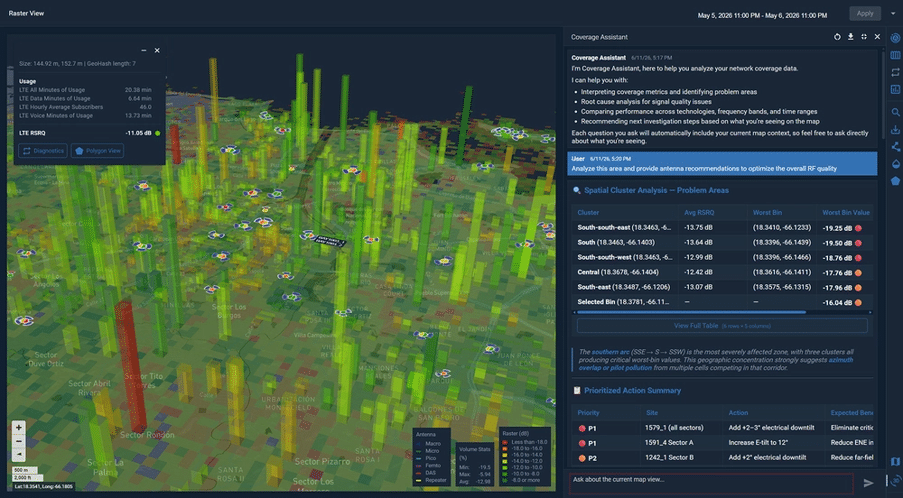
AI is at the heart of VIAVI’s NITRO Location Intelligence, notably in the Anomaly Detection technology for the RAN and core networks, identifying critical issues with fewer false alarms to enable faster, smarter, and more precise fault detection and resolution.
AI is also central in products such as Observer Apex for enterprise-wide visibility into IT service health, the VALOR Lab for Open RAN and AI RAN validation, FiberComplete PRO and OTDR Event Detection for faster bidirectional testing, and NITRO Fiber Sensing, which is used to detect potential threats to critical infrastructure such as gas pipelines or military facilities.
AI Agents for Simplified Testing
In the above, we highlighted the importance for field engineers to be able to access the right information easily using AI Experts. That approach uses precisely configured language models trained for the specific system scenarios they’ll encounter and enables natural language prompts to bring up the exact information they’ll need for a test or to diagnose an issue.
The advent of the Model Context Protocol (MCP) by Anthropic, an open standard for connecting and allowing communication between AI systems, has enabled VIAVI to take this concept one step further.
VIAVI’s award-winning MCP Server Framework enables teams running faster, more complex (800G, 1.6T ports based on 224G SerDes) networks to shift from a world of GUIs and manually written scripts to one based on AI agents that orchestrate and execute testing through natural-language interactions.
This translation from prompt to REST API with configuration simplifies the interaction between infrastructure tools and AI systems. It also reduces the reliance on a dwindling number of highly specialized experts with the ability to script test routines for 1.6T and beyond networks.

The MCP Server Framework can also combine this with other sources, such as live event data from real-time server-sent events (SSE), to enhance decision-making and allow the AI to adapt test execution dynamically.
Data4AI
AI models used to manage networks are only as effective as the data on which they are trained. It’s vital that these models are given accurate data, with systems continually synchronized to ensure they can reflect more than just a snapshot and the predictions they give are based on true recreations of the network as it is, not as it was.
AI systems are increasingly starved for high-quality, trusted, real-world data. This is where VIAVI comes in.
VIAVI, with its array of industry-leading instruments, sensors, probes and assurance platforms, can create a trusted source of truth for AI models to be trained and continuously refined with. Whether to prevent drift in rApps and xApps in a 6G system or to mitigate the effects of tail latency and manage straggler packets in a data center’s transmission fabrics, VIAVI can transform the real world into AI-ready data you can rely on.
Trusted data is only half the picture. As AI moves from training to inference, performance must also be proven under realistic conditions. CyberFlood generates high-scale application traffic to stress inference endpoints and the networks that carry them. Vertex emulates real-world RF channel conditions and TM500 emulates large device populations to validate AI-enabled RAN under load. Together, they show how latency, throughput and reliability hold up before deployment.
In addition, VIAVI enables the physical infrastructure powering these AI models. Through our end-to-end data center portfolio, which was featured at this year’s ECOC, VIAVI provides essential design, manufacturing, and deployment testing for 1.6T scale-up, scale-out, and scale-across architectures. This ranges from L0 to L7 Ethernet fabric validation with the ONE-1600 and TestCenter D2 to testing for co-packaged optics, silicon photonics, QKD, and high-density fiber. By underpinning this with an AI-first approach to our partnerships, we help ensure the most advanced networks can be rolled out reliably to meet the bandwidth and latency demands modern AI clusters require.